Eclipses of the Sun and Moon

Search solar and lunar eclipses for any year. For each — the type and magnitude, the sign and nakshatra of the Sun and Moon, the sutak periods, visibility from your city and the Vedic meaning.

A grahana is the moment when Rahu or Ketu "swallows" the luminary. Traditionally a time of sadhana, japa and mantra; unfavourable for worldly affairs.
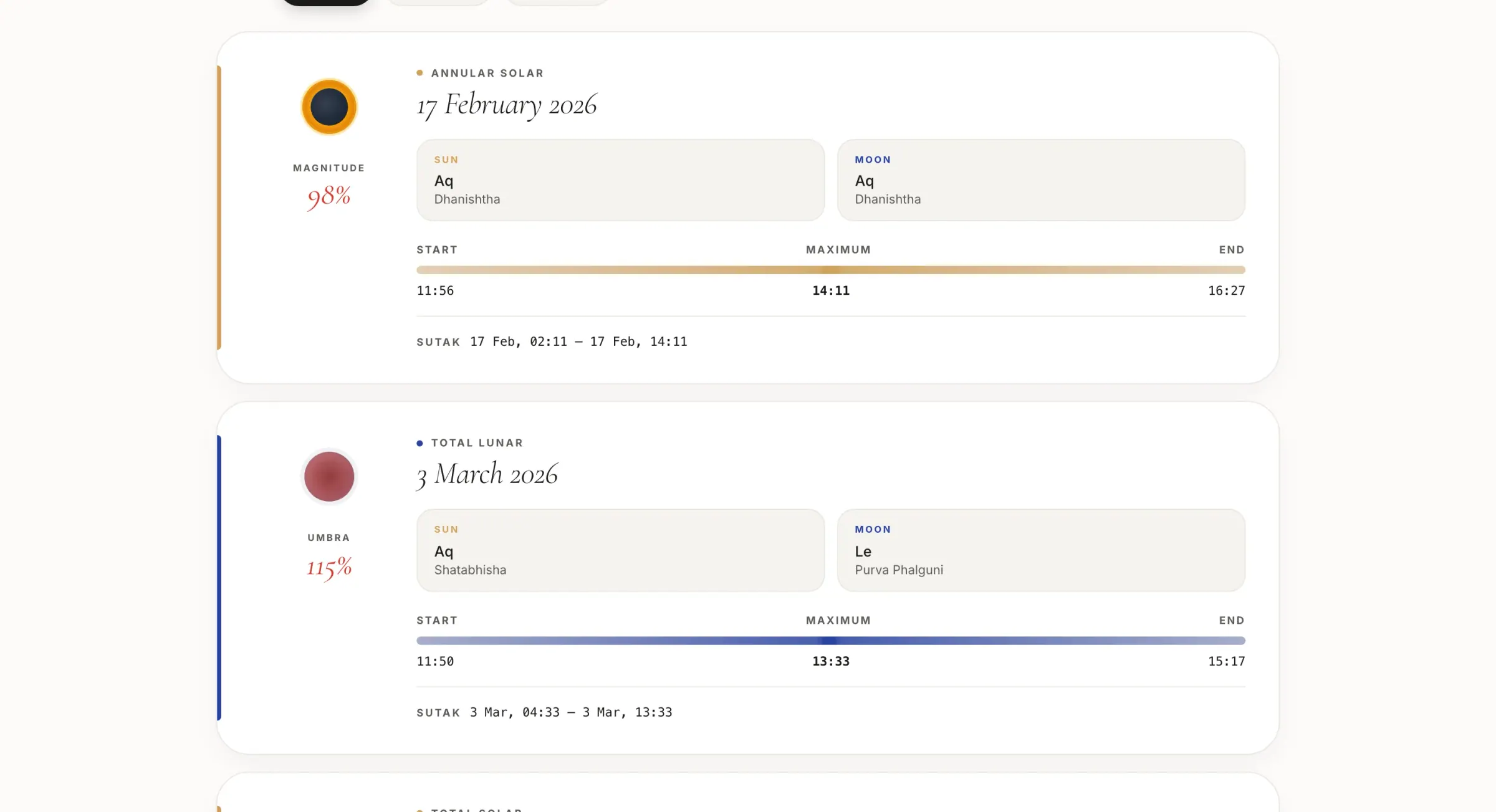
Eclipse cards in Dharmika: a total lunar and a total solar one, the umbra, the sign and nakshatra, the sutak periods
Find your year's eclipses

What the calculation shows

Type and magnitude

Solar (total, annular, partial) and lunar (total, partial, penumbral). Magnitude and the maximum phase, the local start, maximum and end times.

Example: a total lunar eclipse, umbra 115%

Sign and nakshatra

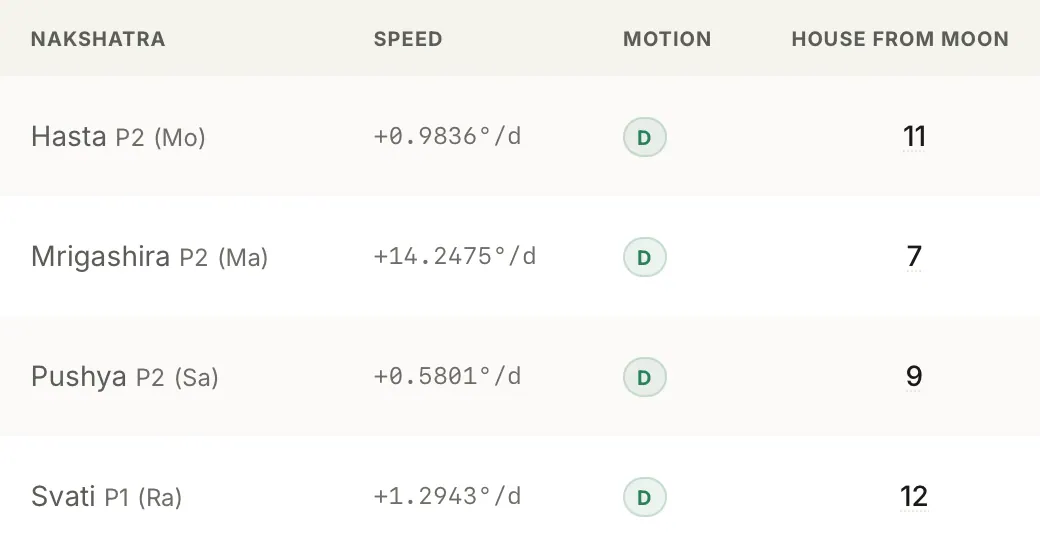
The rashi and nakshatra of the Sun and Moon at the moment of the eclipse. You can see which houses and grahas of your natal chart are touched — for a personal analysis.

Example: the sign and nakshatra of the Sun and Moon at the moment of the eclipse

Sutak periods

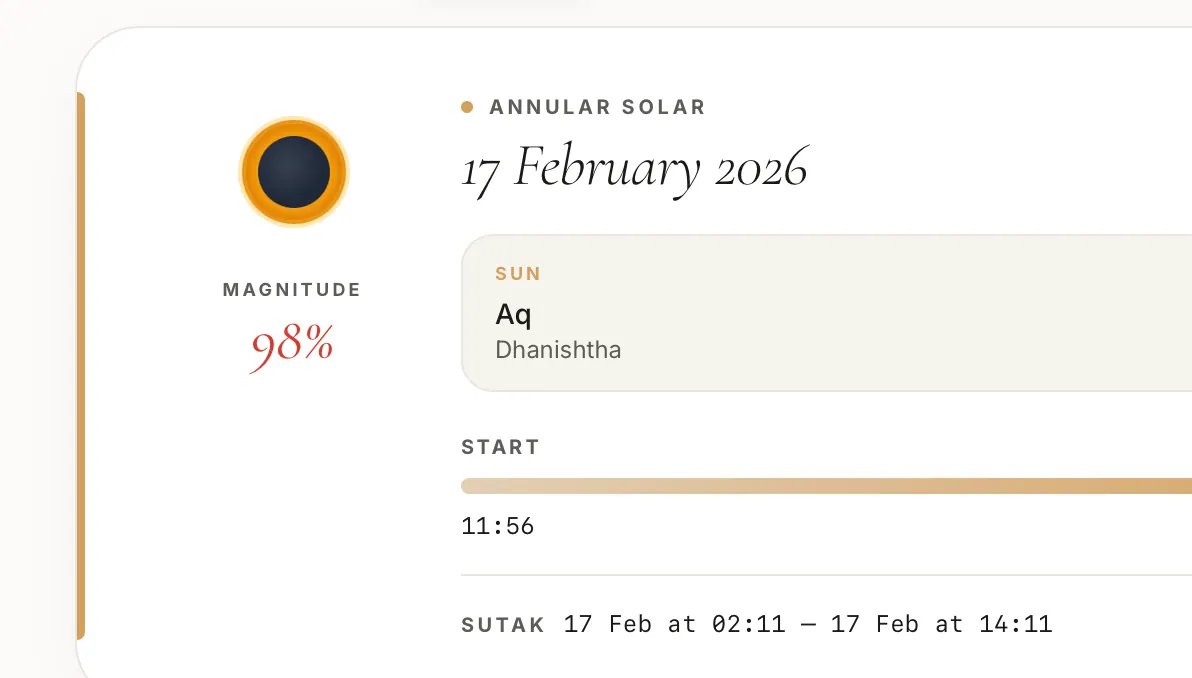
An automatic calculation of the sutak — the period of restraint before and during the eclipse. Its length differs for solar and lunar ones; the times are given for your city.

Example: the eclipse time and the sutak window

Everything about eclipses

Search by years

Quick presets — this year, 3, 5 or 10 years — or an arbitrary range. Every solar and lunar eclipse of the period in one chronological list.

Solar and lunar

Both eclipse types with a filter. Precise ephemeris calculations (Swiss Ephemeris): the type, magnitude, maximum phase and contact moments.

Visibility and local time

Eclipse dates are global, but the time and visibility depend on the place. Name a city — the start, maximum and end times recalculate for your time zone.

The Vedic meaning

An eclipse is Rahu or Ketu and a luminary. The tradition's advice: japa and mantra, an intensification of sadhana, and refraining from food and worldly affairs during the sutak.

Frequent questions

Grahana is an eclipse, when the lunar nodes Rahu or Ketu "swallow" the Sun or the Moon. In the tradition it is a powerful but ambiguous time: unfavourable for worldly affairs, yet strong for spiritual practice — japa, mantra and meditation.

The sutak is a period of restraint before and during an eclipse. For a solar eclipse it traditionally begins earlier (about 12 hours before), for a lunar one it is shorter (about 9 hours). The calculation shows the exact sutak boundaries for the chosen date.

The eclipse date itself is global, but visibility and local time depend on geography. Name a city — the calculation will recompute the start, maximum and end times for your time zone and tell you whether the eclipse is observed in your locality.

The tradition advises devoting the eclipse to spiritual practice: japa, the recitation of mantras, meditation. During the sutak one abstains from food and important worldly affairs, and after the eclipse — performs an ablution. This information is for reference only.

Calculate the eclipses

Choose a year and a city — get a list of eclipses with the type, magnitude, nakshatras and sutak periods.